
Market Update
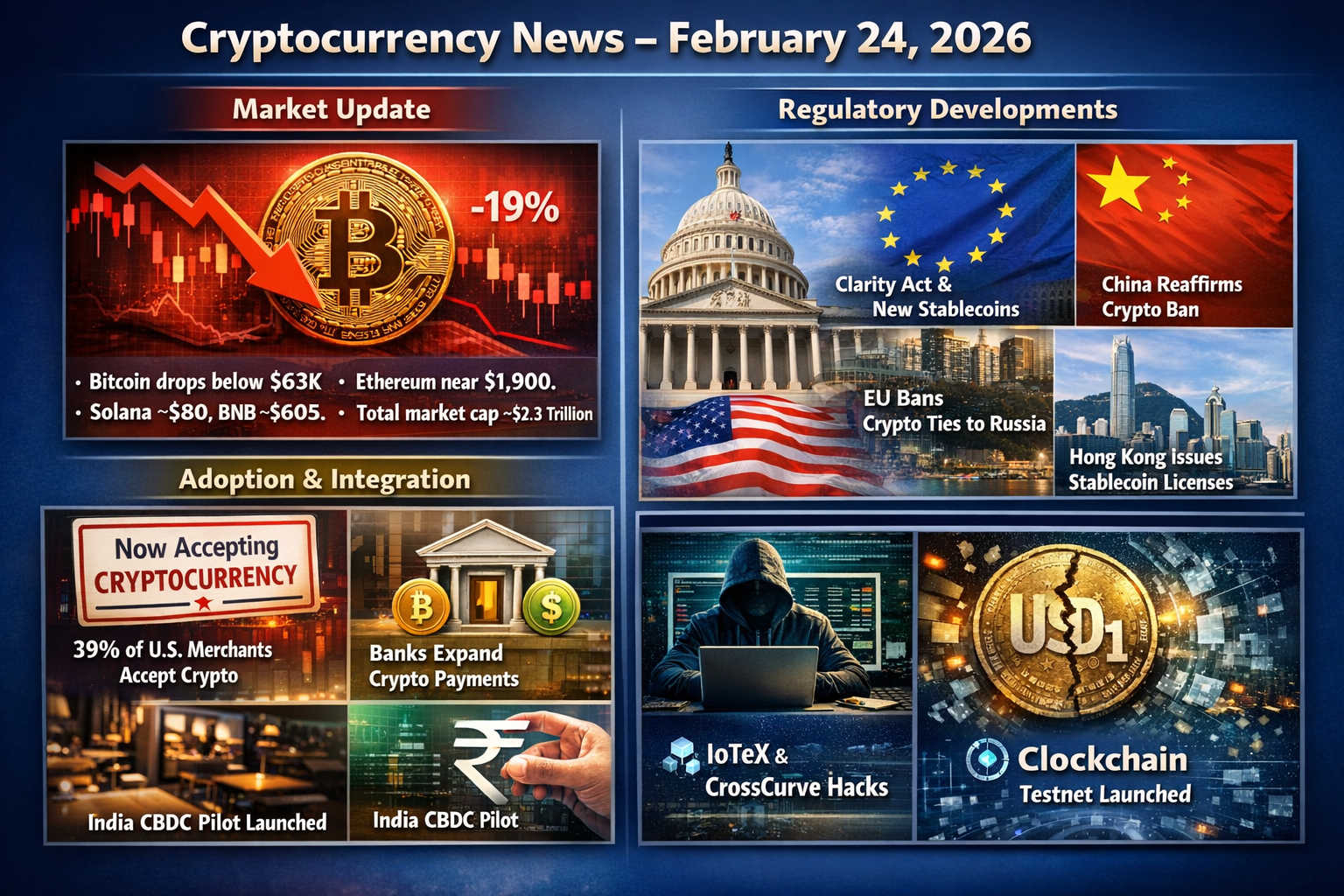
Global cryptocurrency markets experienced a sharp downturn on February 24. Bitcoin dropped into the mid-$60,000 range, briefly falling below $63,000. This marks nearly a 19% decline for February — its worst monthly performance since mid-2022.
Ethereum followed a similar path, trading around $1,900 after suffering notable losses. Major altcoins were hit even harder. Solana hovered near $80, down about 6%, while BNB traded around $605, falling roughly 3%.
The broader crypto market has been under pressure due to global economic uncertainty, including trade tensions and questions surrounding U.S. Federal Reserve policy. Heavy liquidations intensified the sell-off. Overall market capitalization now sits near $2.3 trillion, significantly lower than mid-January levels. Trading volumes surged as investors reacted to the volatility.
Regulatory Developments
United States
U.S. lawmakers continue to push forward major cryptocurrency legislation. Treasury Secretary Scott Bessent has called for a “spring signing” of the Clarity Act, which would place most digital assets under the supervision of the Commodity Futures Trading Commission (CFTC). The House passed its version in 2025, and a Senate draft cleared committee review in January 2026.
At the same time, the new federal stablecoin framework the GENIUS Act is now active. Under this system, Anchorage Digital Bank launched USA₮, a U.S. dollar-backed stablecoin designed to meet federal standards. Fidelity Digital Assets also introduced FIDD, another regulated dollar-pegged stablecoin. Meanwhile, major financial institutions are applying for crypto-related banking licenses, signaling growing institutional involvement.
European Union
The European Union is tightening its crypto regulations, particularly regarding sanctions. Brussels is preparing to ban all cryptocurrency transactions involving Russian-based crypto services as part of its next sanctions package. The goal is to prevent sanctions evasion through digital assets.
Additionally, the EU’s DAC8 tax reporting rules for crypto transactions have come into effect, although some member states are still adjusting to implementation requirements. The European Central Bank continues progressing toward potential Digital Euro legislation, expected by 2026.
China & Hong Kong
Mainland China reaffirmed its strict ban on private cryptocurrencies earlier this month. A joint regulatory notice issued on February 6 prohibits any unauthorized issuance of renminbi-pegged stablecoins, effectively blocking offshore and tokenized asset projects without approval.
In contrast, Hong Kong is expanding its regulated crypto framework. Authorities are preparing new licensing legislation and expect to issue the first official stablecoin licenses in the first quarter of 2026 as part of efforts to establish Hong Kong as a digital-asset hub.
UAE / Middle East
The UAE continues strengthening its crypto framework. In January, Dubai’s financial regulator removed its pre-approved token list, placing more responsibility on licensed firms for compliance assessments.
On February 13, the Central Bank of the UAE approved a dirham-backed stablecoin for institutional use on the ADI blockchain. This move reinforces the country’s ambition to position itself as a leading fintech and blockchain center in the Middle East.
Latin America
Brazil has introduced one of the region’s most comprehensive crypto regulatory systems. New rules that took effect on February 2 require exchanges and service providers to register, segregate customer assets, and comply with foreign exchange laws. The reforms aim to align Brazil with international standards and combat financial crimes.
Africa
In Africa, cryptocurrency remains legal but closely supervised. Nigeria’s 2025 Investments and Securities Act formally classifies cryptocurrencies as securities under SEC oversight. Licensed exchanges are allowed to operate, but strict KYC and AML enforcement continues.
Stablecoins are gaining strong traction across the continent. Nigeria and South Africa, in particular, are seeing growing demand for dollar-backed stablecoins used for remittances and cross-border payments.
Crypto Adoption & Integration
Merchant Adoption
Crypto payments are becoming more common in retail. A recent survey shows that approximately 39% of U.S. merchants now accept cryptocurrency at checkout. More than 80% believe crypto payments will become standard within five years, especially in retail and hospitality sectors.
Financial Institutions
Traditional financial firms are increasingly integrating blockchain infrastructure. Lightspark, led by former Meta executive David Marcus, partnered with Cross River Bank to enable real-time payments via the Bitcoin network. Businesses can now settle USD transactions instantly while using Bitcoin’s network for final settlement. Stablecoin transaction volumes reportedly grew by about 83% in 2025, reflecting accelerating usage.
Government & CBDC Pilots
India launched its first central bank digital currency (CBDC) welfare pilot in Gujarat, distributing grain subsidies through the e-rupee system to over 26,000 families.
Meanwhile, lawmakers in the Philippines are advancing legislation that would require government agencies and many businesses to accept digital payments. These initiatives reflect growing government interest in digital currency systems to improve transparency and efficiency.
Institutional Holdings
Public companies continue expanding their crypto reserves. Bitmine (NYSE: BMNR) announced it holds more than 4.42 million ETH and 193 BTC, making it one of the largest corporate Ethereum holders globally. The company plans to launch MAVAN (Made-in-America Validator Network), a dedicated Ethereum staking infrastructure, in early 2026.
Major Hacks & Security Incidents
IoTeX Bridge Hack
On February 21, the ioTube cross-chain bridge was compromised after attackers gained access to a validator’s private key, stealing approximately $4.3 million. The platform quickly paused operations, and the IOTX token briefly fell by around 22%. The team has offered a 10% bounty in hopes of recovering the stolen funds.
CrossCurve Exploit
CrossCurve, a cross-chain decentralized exchange protocol, suffered a $3 million exploit due to weak access controls in its bridge contract. The team suspended operations to address the vulnerability.
USD₁ Stablecoin Incident
World Liberty Financial reported a coordinated attack involving hacked accounts and market manipulation attempts targeting its USD₁ stablecoin. The token temporarily lost its dollar peg but reportedly returned to parity within hours.
Announcements & New Projects
Clockchain launched its public testnet on February 23, introducing a blockchain-based global time verification system designed to synchronize DeFi, AI, IoT, and financial systems.
Large financial institutions are also expanding stablecoin offerings. Anchorage introduced USA₮, while Fidelity launched FIDD, signaling strong institutional commitment to regulated digital assets.
Bitmine’s upcoming MAVAN staking network further highlights how major crypto holders are building proprietary blockchain infrastructure.
Several startups also conducted token presales this month, but Clockchain’s launch stands out as one of the most technically ambitious developments.
https://cryptodaily.meeqam.com/



 Bitcoin
  Ethereum
  Tether
  XRP
XRP  BNB
BNB  USDC
USDC  Solana
  TRON
TRON  Lido Staked Ether
  Dogecoin
  Figure Heloc
  WhiteBIT Coin
  Cardano
  Bitcoin Cash
  USDS
USDS  Wrapped stETH
  LEO Token
  Hyperliquid
  Wrapped Bitcoin
  Chainlink
  Binance Bridged USDT (BNB Smart Chain)
  Monero
  Wrapped Beacon ETH
  Canton
  Ethena USDe
  Stellar
  Wrapped eETH
  USD1
USD1  Rain
Rain  Litecoin
  sUSDS
sUSDS  Hedera
  Zcash
Zcash  Coinbase Wrapped BTC
  Avalanche
  Dai
Dai  PayPal USD
  WETH
WETH  Shiba Inu
  Sui
Sui  World Liberty Financial
  USDT0
USDT0  Cronos
  Toncoin
  Tether Gold
  Uniswap
  Polkadot
  PAX Gold
  MemeCore
  Ethena Staked USDe