

Primary Keywords: Crypto market 2026, Bitcoin price forecast, Ethereum market analysis, cryptocurrency regulation, institutional crypto adoption
Secondary Keywords: DeFi growth, stablecoins market, Bitcoin volatility, crypto ETFs, blockchain innovation
The State of the Crypto Market in 2026
The global cryptocurrency market experienced significant volatility between 2025 and early 2026, highlighting both the maturity and unpredictability of digital assets. After a strong rally in 2025, major cryptocurrencies entered a correction phase as macroeconomic conditions and investor sentiment shifted.
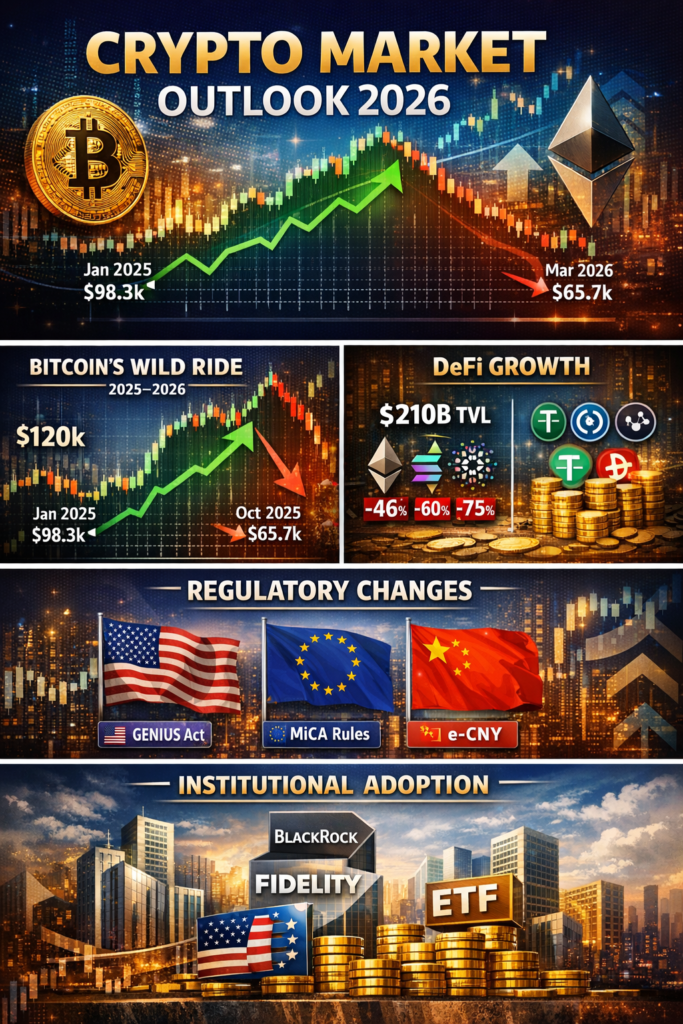
Bitcoin, the largest cryptocurrency by market capitalization, traded around $98,300 in January 2025, surged to nearly $120,000 in October 2025, and later declined to approximately $65,700 by March 2026. Ethereum followed a similar trajectory, dropping from roughly $3,600 to about $1,900 during the same period.
While these price swings may seem dramatic, they are relatively typical for the crypto market. Interestingly, despite large price movements, Bitcoin’s realized volatility dropped to historically low levels, signaling a more stable and mature market structure compared to earlier crypto cycles.
Bitcoin Price Performance and Market Volatility
Bitcoin remains the dominant force in the cryptocurrency market, accounting for more than 60% of total market dominance during 2025. However, the rally that many investors anticipated during 2025 did not fully materialize.
After reaching a peak near $124,000 in October 2025, Bitcoin experienced a sharp correction. By early 2026, the price had declined by about 33% from its peak, reflecting a broader pullback across digital assets.
Despite this correction, the underlying volatility environment changed significantly. Bitcoin’s 30-day volatility fell into the 20–30% range, one of the lowest levels seen in years. This shift suggests that institutional participation and deeper liquidity may be stabilizing the market.
Ethereum and Altcoins: Larger Declines but Strong Ecosystem Growth
Ethereum and other major altcoins experienced even steeper declines compared to Bitcoin. Ethereum lost nearly 46% of its value, while several large Layer-1 networks recorded substantial corrections:
- Solana: down roughly 60%
- Cardano: down approximately 75%
- Dogecoin: down about 76%
- BNB: one of the few outperformers before also declining in early 2026
However, the long-term fundamentals of these networks remain strong. Ethereum continues to dominate the smart contract and decentralized finance ecosystem, supported by its expanding Layer-2 infrastructure.
On-Chain Activity Shows Strong Network Health
Despite the market correction, on-chain metrics reveal that blockchain networks remain highly active and secure.
Bitcoin’s hash rate reached an all-time high of approximately 1.1 zettahash per second in 2025, demonstrating strong miner confidence and network security. Although extreme weather temporarily disrupted mining activity in early 2026, the network quickly stabilized through difficulty adjustments.
User activity also remained steady:
- Bitcoin daily active addresses: roughly 600,000–800,000
- Ethereum daily active addresses: about 620,000 in March 2026
- Bitcoin transactions: approximately 400,000 per day
Transaction costs have dropped significantly as well. Bitcoin fees average around $0.35, while Ethereum transaction fees have declined dramatically due to scaling improvements.
The Rise of Layer-2 Scaling and Blockchain Innovation
One of the most important technological trends shaping the crypto industry is the expansion of Layer-2 scaling solutions.
Ethereum’s ecosystem now includes widely adopted networks such as:
- Arbitrum
- Optimism
- zk-rollups and zkEVM chains
These technologies dramatically reduce transaction costs and increase blockchain scalability. As a result, Ethereum’s average transaction fees have dropped close to zero in many cases.
Meanwhile, Bitcoin’s Lightning Network continues to grow, surpassing $1 billion in monthly transaction volume, making Bitcoin more practical for everyday payments.
DeFi and Stablecoins Continue Expanding
Decentralized finance (DeFi) remains one of the fastest-growing sectors in the cryptocurrency industry. By mid-2025, total value locked (TVL) in DeFi exceeded $210 billion, representing roughly 60% year-over-year growth.
Much of this activity is driven by stablecoins, which have become the backbone of the crypto economy. The two largest stablecoins, USDT and USDC, each have circulating supplies exceeding $180 billion.
These digital dollars power:
- decentralized trading platforms
- crypto lending markets
- global crypto payments
- cross-border transactions
In addition, the tokenization of real-world assets (RWAs) has emerged as a major new trend. Blockchain-based tokenized bonds, funds, and credit products now exceed $16 billion in total value.
Institutional Adoption Is Reshaping the Crypto Industry
Institutional investors are playing an increasingly important role in the crypto market. The approval of spot Bitcoin ETFs in 2024 and Ethereum ETFs in 2024 opened the door for billions of dollars in institutional capital.
By early 2026:
- Total assets in U.S. crypto ETFs exceed $125 billion
- BlackRock’s iShares Bitcoin Trust (IBIT) alone holds about $13 billion in Bitcoin
Large asset managers including Fidelity, BlackRock, and Franklin Templeton are now actively offering cryptocurrency investment products.
This institutional participation has significantly increased market liquidity and legitimacy.
Global Cryptocurrency Regulation Becomes Clearer
Regulation has historically been one of the biggest uncertainties in the crypto market. However, major economies have recently introduced clearer legal frameworks.
Key regulatory developments include:
United States
- The GENIUS Act (2025) created a federal regulatory framework for stablecoins.
- Spot Bitcoin and Ethereum ETFs were approved, expanding institutional access.
European Union
- The MiCA regulation fully came into force in 2024.
- Crypto service providers must now obtain licenses and follow strict compliance rules.
United Kingdom
- The FCA launched a stablecoin regulatory sandbox to encourage innovation.
China
- Cryptocurrency trading remains banned.
- However, the country’s digital yuan (e-CNY) has processed trillions of yuan in transactions.
These developments are gradually integrating crypto into the global financial system.
Macroeconomic Factors Driving Crypto Prices
Cryptocurrency prices remain highly sensitive to global economic conditions. Interest rates, inflation, and liquidity play a major role in shaping investor behavior.
Central banks are expected to gradually ease monetary policy over the coming years. The U.S. Federal Reserve’s benchmark rate is projected to decline toward 3–3.5% by late 2026, which could support risk assets including cryptocurrencies.
However, persistent inflation and geopolitical tensions could still create volatility across financial markets.
Key Risks Facing the Crypto Market
Although the industry continues to grow, several risks remain:
- Regulatory crackdowns in major markets
- Stablecoin failures or de-pegging events
- Cybersecurity breaches and exchange hacks
- Global economic shocks
Investors should carefully consider these factors when entering the crypto market.
Future Catalysts for Cryptocurrency Growth
Despite short-term volatility, several developments could drive the next major crypto cycle:
- New cryptocurrency ETFs and investment products
- Increased corporate adoption of Bitcoin
- Breakthrough blockchain scaling technologies
- Expansion of tokenized real-world assets
- Favorable macroeconomic conditions
Many analysts also believe early Bitcoin accumulation cycles could begin again before the next halving event in 2028.
Final Thoughts: The Future of Cryptocurrency
The cryptocurrency industry in 2026 is far more developed than it was just a few years ago. Institutional adoption, regulatory clarity, and technological innovation have strengthened the foundation of the market.
However, crypto remains a highly volatile asset class influenced by global economic conditions and investor sentiment. As blockchain technology continues to evolve, the coming years will determine whether cryptocurrencies transition from speculative assets into core components of the global financial system.



 Bitcoin
  Ethereum
  Tether
  XRP
XRP  BNB
BNB  USDC
USDC  Solana
  TRON
TRON  Lido Staked Ether
  Figure Heloc
  Dogecoin
  USDS
USDS  WhiteBIT Coin
  LEO Token
  Cardano
  Wrapped stETH
  Bitcoin Cash
  Hyperliquid
  Wrapped Bitcoin
  Chainlink
  Binance Bridged USDT (BNB Smart Chain)
  Monero
  Wrapped Beacon ETH
  Ethena USDe
  Canton
  Stellar
  Wrapped eETH
  MemeCore
  Dai
Dai  sUSDS
sUSDS  USD1
USD1  PayPal USD
  Litecoin
  Coinbase Wrapped BTC
  Zcash
Zcash  Hedera
  Avalanche
  WETH
WETH  Rain
Rain  Shiba Inu
  Sui
Sui  USDT0
USDT0  World Liberty Financial
  Toncoin
  Cronos
  Bittensor
  Circle USYC
  Tether Gold
  PAX Gold
  Ethena Staked USDe
[…] Crypto Market Outlook In 2026 […]
[…] Crypto Market Outlook In 2026 […]