
U.S. Economy: Growth, Inflation, and Employment
Current State of the U.S. Financial System
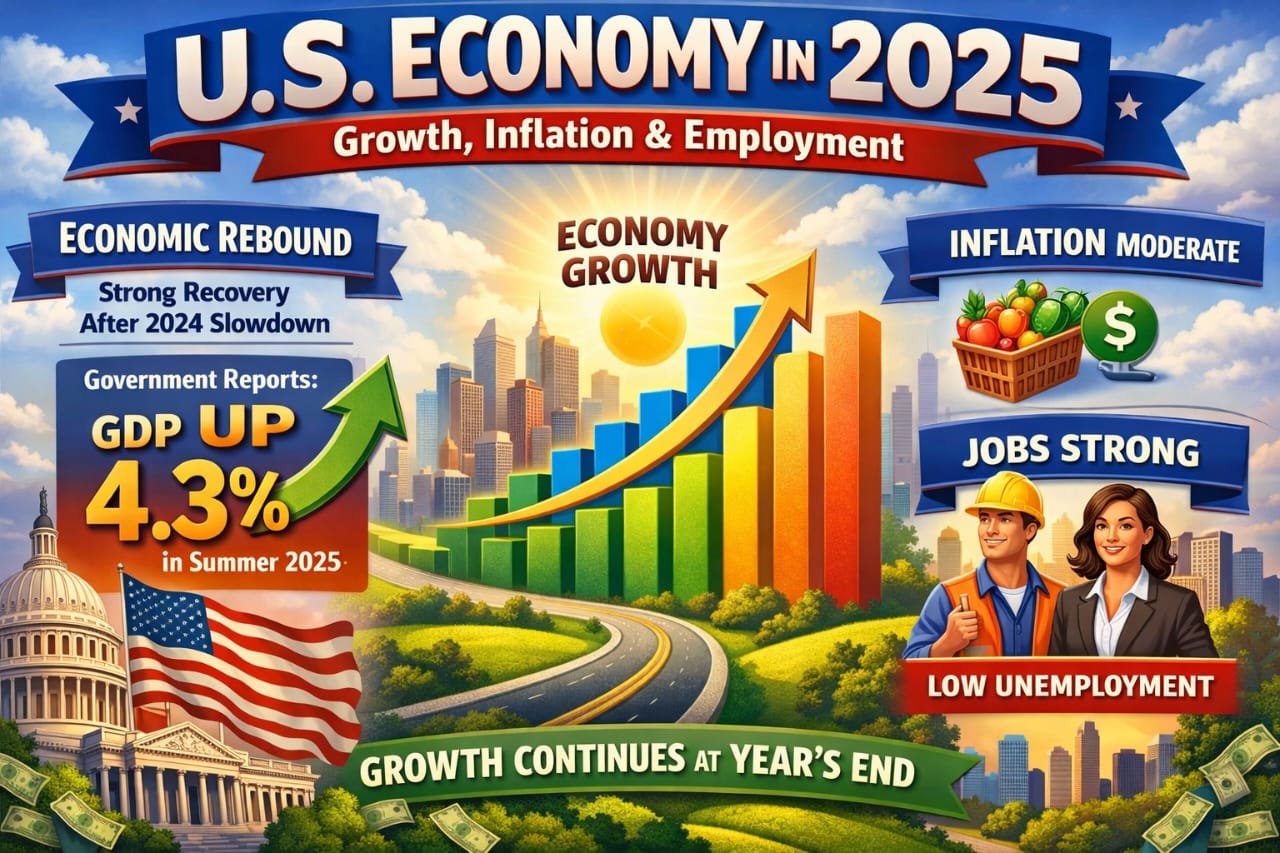
The United States economy got better in 2025. It had slowed down a lot at the end of 2024. Now the government says that the economy grew 4.3 percent in the summer of 2025. Some other people think the economy was still doing well at the end of the year.
The United States economy is expected to grow slowly in 2026 at around 2 to 3 percent. People spent a lot of money. That helped the United States economy grow.. The high tariffs on imports might cause some problems, for the United States economy later on.
Inflation has really gone down a lot from what it was in the past. For example in December 2025 the prices of things were about 2.7% higher than they were the year before. That is a difference from 2022 when inflation was around 9%. Inflation is still a bit higher than what the Federal Reserve wants, which is 2%.
The Federal Reserve is in charge of making sure inflation does not get too high. Experts think that inflation will keep going down in 2026. Since inflation is getting better the Federal Reserve has stopped making interest rates and they have even started making them lower. This is news for inflation and for the Federal Reserve because they are getting closer, to their goal of keeping inflation at 2%.
- The job market is still doing okay. It is not as strong as it used to be.
- In December 2025 the job market added around 50,000 jobs.
- This is not many new jobs as the job market added in past years.
- The job market unemployment rate went down a bit to about 4.4%. People are still getting paid money.
- The average pay for people in the job market went up by, around 3.8% over the year.
- This means that people who have jobs are still doing well even though the job market is not hiring as many people as it used to
- . The job market is still healthy.
- Overall the chance of the job market having a recession soon is still low.
Financial Markets: Stocks, Interest Rates, and Fed Policy
The stock markets did well in 2025. The big indexes, like the S&P 500 went up to all time highs at the end of 2025. The start of 2026. Technology companies were the ones that did the best. A lot of other industries saw growth too. Now the prices of stocks are pretty high when you look at how they have been, in the past so it is possible that the stock markets will not go up fast in the future. The stock markets will probably still do okay in 2026 if the companies keep making money. The stock markets and the S&P 500 are what a lot of people are watching to see what will happen next.
Gold prices and silver prices went up in 2025. This happened because investors thought that interest rates would go down and the U.S. Dollar would get weaker.
The interest rates have started to go down. The Federal Reserve increased the interest rates a lot in 2022 and 2023. Then the Federal Reserve stopped increasing the rates in 2024. The Federal Reserve actually cut the interest rates in 2025.
In December 2025 the Federal Reserve reduced its interest rate to around 3.5–3.75%. People who watch the markets think that the Federal Reserve will cut the interest rates more in 2026. Gold prices and silver prices are likely to be affected by these changes, in interest rates.
Interest rates for a time also went down. The 10-year U.S. Treasury yield went down to about 4.1% by the end of 2025. This shows that people think interest rates will be lower in the future and they really want to invest their money in things. It is still expensive for businesses to borrow money compared to before the pandemic. It is not as expensive as it was in 2022. Interest rates are important, for businesses and interest rates are still something that businesses have to deal with.
The Federal Reserve is paying a lot of attention to helping the economy grow now instead of worrying about inflation. The officials think the economy is doing okay it is growing at a pace and inflation is getting better. When it comes to cutting interest rates in the future the Federal Reserve will look at information about the economy. The Federal Reserve and financial markets are feeling more calm and hopeful, about what’s going to happen next.
Personal Finance Trends: Savings, Debt, and Spending
People in the United States are not saving much money as they used to during the pandemic. The U.S. Savings rate is now 4 to 5 percent of what people earn. This is much the same as it was, before the pandemic. A lot of people spent the money they saved in 2020 and 2021.
Household debt is a problem. It has gone up a lot. By the end of 2025 the total amount of household debt was around $18.6 trillion. Household debt is mostly made up of home mortgages. People also owe money on their credit cards, car loans and student loans. Luckily most people are still paying their bills on time. Not many people are having trouble with debt. However some people are having a time paying back their student loans now that the payments have started again. Student loan debt is becoming an issue for these people. Household debt and student loan debt are still concerns, for many.
The economy is doing well because people are still spending a lot of money. People bought things from stores at the end of 2025. They also spent money on things, like traveling and eating at restaurants. Rich people are spending more money.. People who do not have a lot of money are having a hard time because food and housing are very expensive. If people do not get jobs easily in 2026 consumer spending may not be as strong as it is now.
Banking System: Stability and Regulation
The U.S. Banking system is really doing well. Big banks like the ones in the U.S. Banking system have a lot of money and enough cash to deal with economic times. When they did these tests in 2025 to see how the U.S. Banking system would do it showed that the major banks in the U.S. Banking system could make it through bad economic problems. The people in charge made a small changes to the rules about how much money the banks in the U.S. Banking system need to have so the banks in the U.S. Banking system would buy safer things, like government bonds from the U.S. Government.
Smaller banks and regional banks have a time. The high interest rates are a problem, for them. They have reduced the value of some things that the banks have invested in. Also it is harder for them to get people to put their money in these banks. Because of this many midsize banks are not making much money as they used to.. The good thing is that no big bank has failed since 2023. The people who regulate the banks are watching everything closely and they are making sure that the banks are following the rules.
Public Debt and Fiscal Policy
The United States government spends a lot of money. It spends money than it gets from taxes. In the year 2025 the United States government had a budget deficit of one point eight trillion dollars. The deficit went down a bit at the start of 2026.. The budget deficit is still really big. Experts think the United States government will have deficits every year. They think the budget deficit will be one point seven trillion dollars each year, for a while.
The government debt is really big now. It is over $38 trillion. Because interest rates are going up it is costing the government money to pay the interest on the government debt. A big part of the budget is going to pay interest on the government debt. The government debt is going to keep costing money. This is a problem for the government. It will be a problem for a long time. The government debt is what is causing these problems, for the government.
Government and Regulatory Policy
The government has been working on plans that are all, about technology, digital money and lowering taxes. In the year 2025 they made a new law called the GENIUS Act. This law made rules for something called stablecoins. It says that the people who make stablecoins have to have money to back them up. They also have to protect the people who use them better. The main goal of the GENIUS Act is to help new ideas happen while making sure people do not lose money.
The tax policy changed in 2025. This is when the Working Families Tax Cuts Act came into effect. The Working Families Tax Cuts Act did a things. It reduced tax rates. It increased deductions. The Working Families Tax Cuts Act also provided benefits for workers and seniors.
We think these changes will increase tax refunds in 2026. The tax refunds in 2026 will be bigger because of the Working Families Tax Cuts Act.. There is a downside to the Working Families Tax Cuts Act. Lower tax revenues are a problem. The lower tax revenues, from the Working Families Tax Cuts Act will contribute to budget deficits.
The government has also shown support for fintech and digital assets. Regulators have allowed banks to work more closely with financial technology companies and clarified rules for crypto activities. Overall, policies aim to support economic growth, but long-term issues like rising debt and future financial risks remain unresolved.https://www.facebook.com/share/1ArNYsN51s/

 Bitcoin
  Ethereum
  Tether
  XRP
XRP  BNB
BNB  USDC
USDC  Solana
  TRON
TRON  Lido Staked Ether
  Dogecoin
  Figure Heloc
  WhiteBIT Coin
  Cardano
  Bitcoin Cash
  USDS
USDS  Wrapped stETH
  LEO Token
  Hyperliquid
  Wrapped Bitcoin
  Chainlink
  Binance Bridged USDT (BNB Smart Chain)
  Monero
  Wrapped Beacon ETH
  Canton
  Ethena USDe
  Stellar
  Wrapped eETH
  Rain
Rain  USD1
USD1  Litecoin
  sUSDS
sUSDS  Hedera
  Zcash
Zcash  Coinbase Wrapped BTC
  Avalanche
  Dai
Dai  PayPal USD
  WETH
WETH  Sui
Sui  Shiba Inu
  Toncoin
  USDT0
USDT0  Cronos
  World Liberty Financial
  Tether Gold
  Polkadot
  Uniswap
  PAX Gold
  MemeCore
  Ethena Staked USDe