
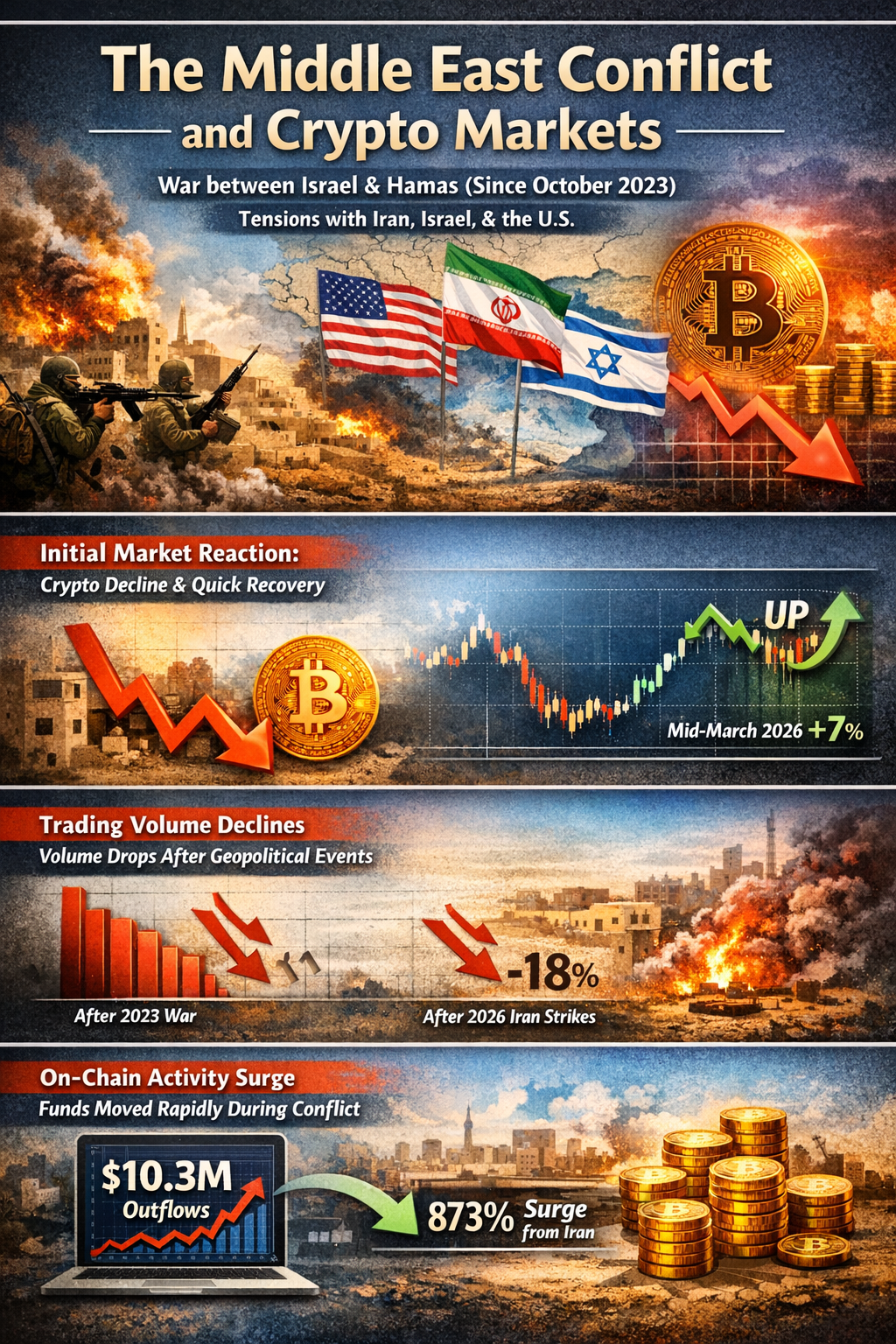
The Middle East conflict, including the war between Israel and Hamas (since October 2023) and rising tensions involving Iran, Israel, and the United States, has had a significant impact on crypto markets. These geopolitical events have influenced prices, trading behavior, and investor sentiment.
Initial Market Reaction:
At the start of the conflict, Bitcoin and major cryptocurrencies experienced a short-term decline. However, this drop was temporary, and prices quickly recovered, showing the market’s resilience. By mid-March 2026, Bitcoin had risen about 7% from its late-February low, even as traditional safe-haven assets like gold declined.
Trading Volume Declines:
During major geopolitical events such as the October 2023 war outbreak and the February 2026 Iran strikes crypto trading volumes dropped significantly. For example, Bitcoin’s 24-hour trading volume fell by 17% after the war began and 18% after the Iran strikes, indicating reduced market participation during uncertainty.
On-Chain Activity Surge:
On-chain data showed increased movement of funds during the conflict. On February 28, 2026, exchange outflows surged by 873%, with about $10.3 million in Bitcoin transferred out of Iran within hours. This reflects rapid capital movement and risk response by investors.
Derivatives and Risk Hedging:
Derivatives markets revealed growing caution. Funding rates for altcoins initially rose but later declined as tensions escalated. At the same time, options markets showed increased demand for put options, signaling that investors were hedging against potential losses.
Regional Differences:
The impact of the conflict varied by region. In the UAE and Gulf countries, crypto markets remained stable and active, with continued blockchain innovation. In contrast, Iran’s crypto sector faced disruptions from internet blackouts and international sanctions, including actions targeting exchanges and financial networks.
Shift from Risk to Opportunity:
Initially, crypto behaved like a risk asset, declining alongside stocks and oil. However, markets later attracted fresh capital, with about $1.1 billion flowing into Bitcoin ETFs by early March 2026. This highlights crypto’s dual role as both a risk-sensitive and emerging alternative asset.
Timeline of Key Events
- October 7, 2023: Hamas attacks Israel, starting the Gaza war
- November 2023: Continued conflict despite ceasefire discussions
- January 3, 2024: Bombing in Iran
- October 26, 2024: Iran launches missile strikes on Israel
- June 2025: 12-day escalation between Iran and Israel
- February 28, 2026: U.S. and Israel strike Iran, intensifying tensions
Price Volatility and Recovery:
Crypto prices dropped during major conflict events but consistently rebounded afterward. For instance, Bitcoin fell 6% within 45 minutes after the February 2026 strikes but later recovered to around $72,800 by mid-March. Earlier, it had reached $44,000–$49,000 by January 2024 after the initial shock.
Volatility and Market Metrics:
Market volatility increased during the conflict. Bitcoin trading volume fell again by 18% after the Iran strikes, while Solana’s volatility rose by about 2.3%, reflecting heightened uncertainty.
Stablecoin Activity:
Stablecoins became highly active, particularly in affected regions. There were reports of large-scale USDT purchases, indicating demand for liquidity and financial stability during the crisis.
Investor Behavior:
Funding rates, options data, and exchange flows all pointed to defensive positioning. Investors moved assets, reduced exposure, and used hedging strategies to manage risk.
Regional Market Behavior:
In Iran, there was high demand and large capital outflows. In countries like Israel and Lebanon, some investors sold crypto to raise cash, showing different responses based on local conditions.
Crypto in the GCC:
In the Gulf Cooperation Council (GCC), especially the UAE and Saudi Arabia, crypto trading remained strong and uninterrupted. Exchanges in Dubai and Abu Dhabi continued operating, and blockchain adoption expanded, supported by regulatory clarity and digital infrastructure.
Regulatory Actions:
Governments increased crypto-related enforcement. The United States and its allies imposed sanctions on entities linked to illicit financing. This included blacklisting companies, targeting crypto wallets, and restricting exchanges connected to militant groups.
Market Sentiment:
Investor sentiment weakened during peak tensions, with indicators falling into “fear” territory. However, interest in Bitcoin as a potential safe haven increased, and some analysts noted its outperformance compared to traditional assets.
Crypto Use in Conflict:
Cryptocurrencies were used for fundraising and sanctions evasion. Authorities responded by freezing assets and monitoring blockchain activity. In some regions, crypto became part of broader economic and geopolitical strategies.
Key Takeaways:
Geopolitical conflict increases short-term volatility in crypto markets, but the sector has shown strong recovery and adaptability. For investors, risk management and diversification are essential. For policymakers, the growing role of crypto highlights the need for strong regulation, transparency, and international cooperation.



 Bitcoin
  Ethereum
  Tether
  XRP
XRP  BNB
BNB  USDC
USDC  Solana
  TRON
TRON  Lido Staked Ether
  Figure Heloc
  Dogecoin
  USDS
USDS  WhiteBIT Coin
  LEO Token
  Cardano
  Wrapped stETH
  Bitcoin Cash
  Hyperliquid
  Wrapped Bitcoin
  Chainlink
  Binance Bridged USDT (BNB Smart Chain)
  Monero
  Wrapped Beacon ETH
  Ethena USDe
  Canton
  Stellar
  Wrapped eETH
  MemeCore
  Dai
Dai  sUSDS
sUSDS  USD1
USD1  PayPal USD
  Litecoin
  Coinbase Wrapped BTC
  Zcash
Zcash  Hedera
  Avalanche
  WETH
WETH  Rain
Rain  Shiba Inu
  Sui
Sui  USDT0
USDT0  World Liberty Financial
  Toncoin
  Cronos
  Bittensor
  Circle USYC
  Tether Gold
  PAX Gold
  Ethena Staked USDe